
轩辕剑之汉之云
Vessel tests begin along China's major river-to-sea Pinglu Canal_我的网站

A |
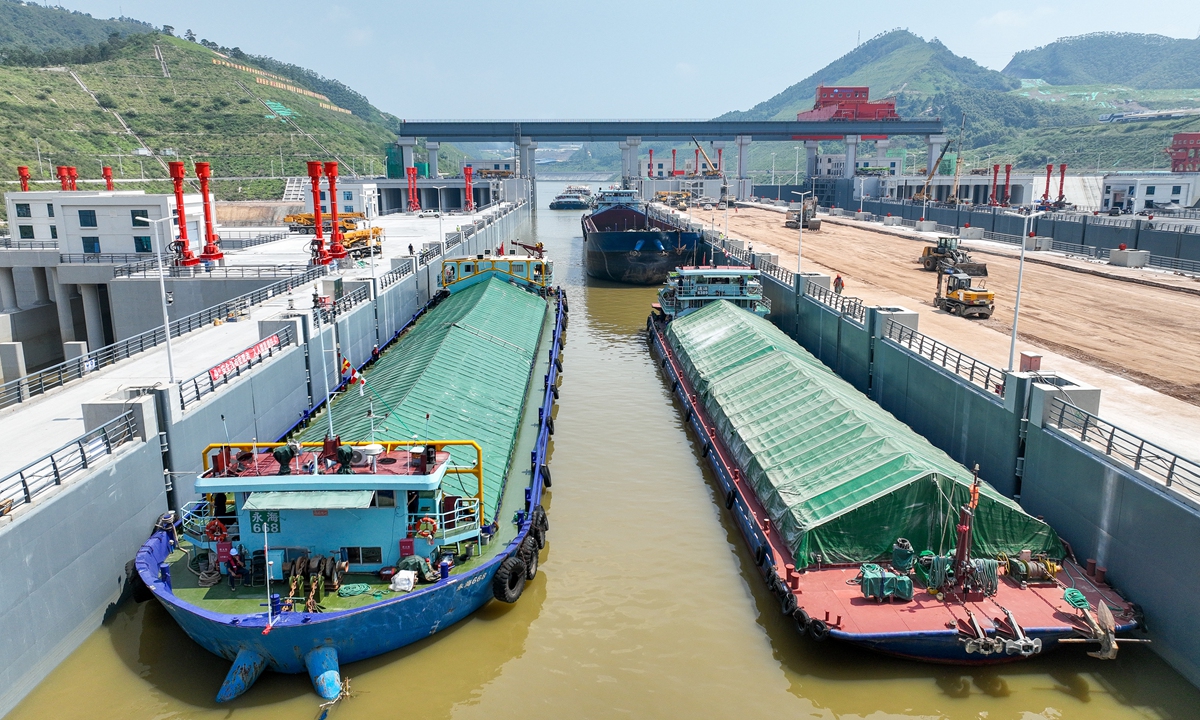
Equipped with China's homegrown BeiDou positioning systems, drones and sensors, four vessels began trial runs along China's Pinglu Canal on Wednesday. The canal, which is planned for opening in September, will greatly inject economic vitality to areas along its route and turbocharge China's trade connection with the ASEAN with its cost-saving transportation, a Chinese analyst said.
The vessels conducting trials on Wednesday represent the main types expected to sail on this canal, namely loaded and unloaded 5,000-tonne ships as well as loaded 3,000-tonne and 1,000-tonne vessels, Xinhua News Agency reported.
The trials began when an unloaded 5,000-ton vessel departed from the Xinfu service area along the canal in South China's Guangxi Zhuang Autonomous Region, the Xinhua News Agency reported.
With sensors collect data on their routes, movements, water currents and safe distances between ships, the tests will assess navigation under both normal and adverse conditions and examine whether the canal's waterways, locks, anchorages, service areas and navigation facilities are ready for operation.
Chinese analysts said the tests starting on Wednesday, days after the canal completed its first full-route patrol, indicated that the canal is one step closer to its scheduled opening in September as final preparation work ramp up.
Zheng Ping, chief analyst at industry news portal chineseport.cn, told the Global Times on Wednesday that as a major project in the nation's water network, the opening of the canal later this year will bring sea changes to areas along its route with fresh economic opportunities with its role as a low-cost enabler for domestic and international trade.
"Inland water traffic has great advantage in transportation capacity and costs. While a train can typically carry 20 40-foot container or more, a waterborne vessel can easily carry over 100 such containers. So a five-times capacity is gained here, greatly reducing transportation costs for goods," Zheng said.
For goods that are not time sensitive, or for bulk cargo such as coal, aluminum or fertilizers, waterborne traffic has unparallel advantage, the expert noted.
The 134.2-kilometer-long Pinglu Canal is a key project of the New International Land-Sea Trade Corridor. With total investment exceeding 70 billion yuan ($10.37 billion), the canal begins at the Pingtang River estuary in Hengzhou, administered by Nanning, follows the Qinjiang River into the Beibu Gulf, according to Xinhua News Agency.
It is China's first major river-to-sea canal project planned and coordinated at the national level since 1949 and is designed to accommodate vessels of up to 5,000 tons.
In addition to facilitating transportation, modern canal system will also have the function of water resource diversion, flood control and irrigation, greatly boosting up local economic development, Zheng said.
Lei Xiaohua, deputy director of the Institute of Southeast Asian Studies at the Guangxi Academy of Social Sciences in South China's Guangxi Zhuang Autonomous Region, told the Global Times on Wednesday that the Pinglu Canal will serve as a new engine for the deep integration of industrial chains between China and ASEAN.
"Raw materials from ASEAN can enter China's hinterland via the Beibu Gulf ports at lower costs, while Chinese exports including aluminum products and building materials can reach Southeast Asia more efficiently," Lei said.
Against the backdrop of deep industrial chain integration between China and Vietnam, the canal, which offers a low-cost, high-capacity transport route, is poised to foster new models of cross-border industrial capacity cooperation, said Lei.
When operational in September, the canal will give inland regions in Southwest China a more direct river route to the sea. Cargo that previously had to travel eastward through the Port of Guangzhou will be able to head south directly toward ports in the Beibu Gulf, shortening some inland waterway journeys by about 560 kilometers, according to Xinhua.
The New International Land-Sea Trade Corridor is an international trade and logistics network connecting China's western regions to ASEAN countries and other overseas markets.
The corridor has continued to record strong trade growth. During the first half of 2026, imports and exports transported through the corridor by its participating regions reached 517.23 billion yuan, up 13 percent year-on-year and setting a new record for the same period, per data released by Chongqing municipal government.
The corridor's rail service handled a record 1.425 million 20-foot equivalent units of cargo in 2025, up 47.6 percent year-on-year. As of early June of 2026, its network reached 593 ports in 128 countries and regions.
。 贵阳8月23日电(记者肖艳、李黔渝)23日上午,贵州首列采用“保税物流+铁路快通”新模式的回程中老班列顺利抵达贵阳国际陆港,该班列共装载40个标准集装箱、1100吨进口钾肥,从老挝万象南站出发,用时5天直达贵阳。 “保税物流+铁路快通”是一种高效便捷的国际物流通关模式。据了解,出海通道长、物流成本高长期以来是掣肘贵州外贸发展的堵点难点。在新模式下,进口货物班列在入境口岸无需停留,相当于把进口口岸延伸到了贵阳属地,企业在筑城海关进行一站式申报、查验、放行,大幅提高了通关效率,同时提升班列运行效率,有效压减物流成本。进口货物享受贵阳综保区“境内关外”政策,在区内仓储免缴进口税款,可有效减轻企业资金压力,加速资金流转。 贵州作为西部陆海新通道的重要节点,近年来持续深化与东盟国家的经贸合作。

B | 中老铁路作为“一带一路”倡议下的标志性工程,为贵州与老挝、泰国等东盟国家之间的贸易往来提供了便捷的铁路运输国际大通道。此次回程班列的成功开行,在贵州和东盟国家之间打通了一条高效的返程直达通道,实现了贵州从“出口单向流动”到“进出口双向循环”的根本性转变。 据了解,下一列满载钾肥的回程中老班列将于3天后到达贵阳国际陆港。
Current article:http://ce7r.guizhuanguchuanluanzhoudi.shop/list_co22k/cbktlmk.html
Published on:21:59:02
情牵两世_Random reading
- 08-23《世界泉州》系列报道:把世界“味”装进泉州“胃”
- 08-24郑钦文胜尤晓迪 晋级美网资格赛次轮
- 08-20索尼PS5 Accolades功能因“未达到预期水平”将于今秋停用
- 08-26‘Attempt to Claim Ownership Over Human Bodies’: Kamala Harris Likens Roe v. Wade Reversal to Slavery
- 08-24独家V观丨你好 哈萨克斯坦
- 08-20英媒:布阿迪8600万镑转会曼城,大幅刷新英超U20球员转会费纪录
- 08-24中国跳水“梦之队”戴上“百金”桂冠
- 08-24韦东奕下架练习册,四天销售额超100万元
- 08-26内娱男演员,开始贩卖“易碎感”
- 08-26苹果拟推出全新Mac mini:跳过M5 搭载M6芯片

家政妇三田_Active users
- 新时代文明实践 | 钱清街道开展“与梦想童行”中国梦想日主题活动
- 超飒超燃!抚顺市开展青少年国防教育实训体验研学活动
- 苏州夺冠归来,邯郸小将观战五超:长大后,我要为家乡而战!
- 中欧班列(西安)今年已向欧洲输送制冷家电超3.4万台,中欧班列(西安)今年已向欧洲输送制冷家电超3.4万台
- 土以关系升温或难持久
- 古田县:一只“蚂蚁”的1762小时
- 小斯:倾尽所有为尼克斯 球迷配得上这座冠军
- 海马课堂网络科技大连有限公司虚假宣传,诱骗
- “钼”成300层+NAND必选项 机构:沉积设备迎10亿美元增量市场
- 以色列政客拿大锤砸毁巴勒斯坦纪念碑,砸完后发照片炫耀:村子每个孩子路过这里,看到纪念碑,都会想着长大后成为那样的人,所以必须毁掉
- How Chinese Military Applies Psy-Op Tactics to Counter US Visits to Taiwan
- 牛车水中秋节灯饰本周五亮相 最大型的灯笼高达八米
- 外星区-51m追光笔记本上架:台式i9/rtx 2080,47999元
- 从震动硅谷到喊话马斯克“欢迎掰手腕”,Kimi做对了哪些
- 61歳にして「水玉ワンピ」を難なく着こなすソフィー妃が「素敵すぎ...」と話題に。"イタくならない"上品さが高評価
- 插混动力/综合续航1360km 定价是关键!一文看懂新款沃尔沃XC60
- 2.5K价位也有5倍潜望长焦,小米17T为你解锁远处美景
- 或命名方程豹钛7 方程豹品牌发布旗下全新车型预告图
极限挑战_Hottest this week
- 轩辕剑之汉之云 copyright
- Some of the content comes from the Internet. If you have any offence, please raise it.